Thursday, January 31, 2008

...the hunter gets captured by the game


Vampire Hunting Kit, Mid-19th Century
An incredible Victorian novelty. Complete in mahogany box with revolver, silver bullets, garlic powder, silver dagger, ivory cross, mirror, Professor Blomberg`s New Vampire Serum, wooden stake, etc, etc.The bullets was manufactured-by one Nicolas Plomdeur, gunsmith from Belgium. Plomdeur participated in the Great Exhibiton in 1851, London, Comes with instructions on use and original pamphlet on vampires by Prof Ernst Blomberg. Small 8:o, 19 pages.

dream record 1/31/2008


…I had taken the day off from work. It was a Friday but the day I had requested off was a Monday. Confusion abound. So I walked from my apartment which was my apartment (but wasn’t my apartment) to the beach. I had been to that beach but couldn’t tell you when or where it exists in reality. I set up a tent. The blue tent I camped out in as a child. The sand was blowing all over. I stripped down and walked to the water. AGAIN, I had all these weird tattoos all over me. This time they were smiley faces and crooked stars. I didn’t ink them myself in the dream, but it was implied within the context of the dream that I had done so previously. The ocean was amazing. There was this wicked undertow. It kept on taking me out further and further but I wasn’t scared. The horizon seemed like it was a “physical” thing.

When I got out of the water and towled off the tattoos disappeared, well some of them anayway. The scene then switched it was Thanksgiving and I had vacuumed my parents living room. My father stood by the piano screaming at me. The rug wasn’t clean enough. Then I was back in my apartment, again, cooking a Turkey. Awake.

Wednesday, January 30, 2008

old hat

Since this news story surfaced a couple of years ago about a British teen's internet-suicide/murder plot, I continually find myself revisiting it, capitivated. Its definately movie-worthy, yeah? (see below)

Internet Murder Plot

The boys met in an MSN chatroom. A 14-year-old boy who persuaded his friend to kill him in an internet chatroom had spent months writing stories about the murder plot.

Police found 56,000 lines of text on the boy's computer, who has been dubbed Boy B throughout his trial at Manchester Crown Court.

The amazingly complex stories revolved around eight main characters, including Boy B as himself and his friend, known as Boy A.

The other characters were all fictional.

Boy B started writing to Boy A in early 2003, posing as a teenage girl.
The fictional 16-year-old girl then introduced Boy A to Boy B on an MSM chatroom.
Boy A was led to believe the girl was Boy B's step sister, and the pair soon became a "cyber-couple."

The fictional stories, later found on Boy B's computer, were lived out in the internet chatroom.
The fictional girl introduced Boy A to what she claimed was her natural brother and Boy B's step brother.

Then another boy was introduced, and began to stalk Boy B. Boy B's girlfriend was supposedly killed by the stalker. The girl's brother then committed suicide, leaving Boy A, Boy B and the stalker communicating with each other. Then another girl was introduced into the web, who was the character of a British spy on a mission to protect Boy B.

By this time, Boy A was beginning to doubt his sanity. The spy, who was then killed off in the chatroom 'story', sent Boy A an e-mail saying: "By the time you read this I will be dead."

After this, the main character of the story, a 39-year-old spy, was introduced.
She convinced Boy A that he would be recruited as a spy, if he did what she told him to do.
She led Boy A to believe that Boy B had a tumour and was costing the government too much money. She ordered Boy A to kill Boy B, and if he succeeded he would be rewarded by being taken on as a spy.

The spy and Boy A planned the killing online, to take place on 28 June 2003.
The following day, the boys met at The Trafford Centre, where they bought a kitchen knife before going to Altrincham, Greater Manchester, and Boy A carried out the attack.

...the cadillac pulls out of the graveyard


Illustrations by Stella Langdale, from the book "The Dream Of Gerontius." 1916

Tuesday, January 29, 2008

Drawings Of Aliens By Child Abductees


Ave Lucifer/Dream Record 1/29/2008


…I was visiting my ex-girlfriend’s brother at his college dorm. He wasn’t him, he looked like a child actor all grown up. We sat in his dorm room, crosslegged on the floor. I think we were baked, but I can’t/don’t remember seeing us smoking any marijuana. I put a cassette tape into a CD player (literally) and told him it was the 13th Floor Elevators, but it wasn’t. We walked out onto a patio. There was a warm rain. I told him he should barbecue out on the patio. He said that he did but had lost the top to the grill. When we walked back inside there was a girl with all these piercings and that haircut where it is long in the front and short in the back: I told her I wanted XY and Z tattooed on my arms. She started tracing these weird symbols. These crooked childlike stars, these black obelisks and this weird “eye in a arcing open teardrop,” that I found inside an Os Mutantes album jacket. The girl rushed through the process. I felt like I had gotten a bad haircut or something.

The last thing I remember I was in a shower with windows, lots of light and the ink from the tattoos was running off me in streams, but the tattoos remained in tact on my skin. Eerie.


Monday, January 28, 2008

oh double negatives, you


Here is a symbol in which
Many high tragic thoughts
Watch their own eyes.....

Married to the massive
Mysticism of stone,
Which failure cannot cast down
Nor success make proud.

Globsters


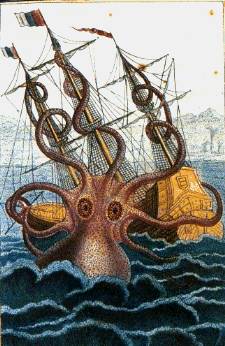
A globster, or blob, is an unidentified organic mass that washes up on the shoreline of an ocean or other body of water. It is distinguished from a normal beached carcass by being hard to identify, at least by initial untrained observers, and by creating controversy as to its identity. Globsters may present such a puzzling appearance that their nature remains controversial even after being officially identified by scientists. Some globsters lack bones or other recognisable structures, while others may have bones, tentacles, flippers, eyes or other features that can help narrow down the possible species. In the past these were often described as sea monsters, and myths and legends about such monsters may often have started with the appearance of a globster. Globsters are most frequently studied in the field of cryptozoology.
The term globster was coined by Ivan T. Sanderson in 1962 to describe the Tasmanian carcass of 1960, which was said to have "no visible eyes, no defined head, and no apparent bone structure."
Many globsters have initially been described as gigantic octopuses, although they later turned out to be the decayed carcasses of whales or large sharks. As with the "Chilean Blob" of 2003, many are masses of whale blubber which have been released from decaying whale corpses. Others initially thought to be dead Plesiosaurs later turned out to be the decayed carcases of basking sharks. Others remain unexplained. Giant and colossal squid may also explain some globsters, particularly those which are tentatively identified as monster octopuses.
Some globsters have only been examined after they had decomposed too much to be used as evidence for a new species, or have been destroyed, as happened with the famous "Cadborosaurus willsi" carcass, found in 1937. However, Canadian scientists did in fact perform a DNA analysis of the Newfoundland Blob which indicated that the tissue was from a sperm whale. In their resulting paper, the authors point out a number of superficial similarities between the Newfoundland Blob and other famous globsters, concluding a similar origin for those globsters is likely.


Sunday, January 27, 2008

shiny things shining brighter in the dark

"everything that is found is always lost again, and nothing that is found is ever lost again."

yeah?

Saturday, January 26, 2008

fakir makir/dream record 1-26-2008


...I was laying in a field of what I can only describe as "wooden tulips." There was a high sun atop the field, thin clouds....The contrast in the blue of the sky wasn't from this reality more like the kind found in retouched photographs...I laid fearful with a memory from childhood. When I was nine or ten I had asked my Mother if she had ever dreamed of her own death, she said "Yes, I walked out into a field and laid down." Not knowing whether or not this was death I closed my eyes and suddenly I was in my apartment and cats were slinking out of a nonexistant crack in the wall. Dozens of cats, many dozens of cats...Had I not woke up maybe trillions of cats, piling out into the street and out on to the Garden State Parkway...My landlord would have been totally pissed and his dog would have went fucking nuts


things of varying importance to me:


seeing odetta on tavis smiley last night
dennis kucinich sadly withdrawing his bid for the democratic nomination (voting won't be nearly as fun now)

enjoying the exploits of milwall fans on 'you tube,' and not knowing anything about soccer

playing finger cymbals along to cal tjader, chiefly 'the fakir' and 'crunchy frito man.'
'witches bible'

coffee

Friday, January 25, 2008

so what if a piece of wood discovers it's a violin?


Dennis Cooper's long-awaited, new book of poems, entitled 'The Weaklings' is now available for pre-order from Fanzine Press. This deluxe version of 'The Weaklings' (DC's first book of poetry since 1995's 'The Dream Police') comes in a hardbound edition with illustrations by Jarrod Anderson and is limited to only 300 copies... in other words, get in quick or you will miss out!

frustration(s)


If I had a shiny gun
I could have a world of fun
Speeding bullets through the brains
Of the folks that cause me pains.
Or, if I had some poison gas
I could make the moments pass
bumping off the numbers of
people whom I do not love.
But I have no lethal weapon --
Thus does Fate our pleasure step on!
So they still are quick and well
Who should be, by rights, in hell.

sandozlot


Los Angeles, April 8, 1984- Former Pittsburgh Pirates' pitcher Dock Ellis says he was under the influence of LSD when he pitched a 1970 no-hitter against the San Diego Padres.
Ellis, now co-ordinator of an anti drug program in Los Angeles, said he didn't know until six hours before his June 12, 1970 no hitter that he was going to pitch.
"I was in Los Angeles, and the team was playing in San Diego , but I didn't know it. I had taken LSD..... I thought it was an off-day, that's how come I had it in me. I took the LSD at noon. At 1pm, his girlfriend and trip partner looked at the paper and said, "Dock, you're pitching today!"
"That's when it was $9.50 to fly to San Diego. She got me to the airport at 3:30. I got there at 4:30, and the game started at 6:05pm. It was a twi-night doubleheader.
I can only remember bits and pieces of the game. I was psyched. I had a feeling of euphoria.
I was zeroed in on the (catcher's) glove, but I didn't hit the glove too much. I remember hitting a couple of batters and the bases were loaded two or three times.
The ball was small sometimes, the ball was large sometimes, sometimes I saw the catcher, sometimes I didn't. Sometimes I tried to stare the hitter down and throw while I was looking at him. I chewed my gum until it turned to powder. They say I had about three to four fielding chances. I remember diving out of the way of a ball I thought was a line drive. I jumped, but the ball wasn't hit hard and never reached me."
The Pirates won the game, 2-0, although Ellis walked eight batters. It was the highpoint in the baseball career of one of the finer pitchers of his time, and arguably,one of the greatest achievements in the history of sports

Thursday, January 24, 2008

...and in it put a spider

In centuries past, there were six mysterious natural treasures from far off lands that ancient rulers craved above all others: walrus ivory for the crosiers of Christian bishops and the sword hafts of Muslim princes; the coco-de-mer, a voluptuously shaped 50-lb nut that bestowed bliss and health, and grew, it was said, in forests beneath the sea; mammoth tusks that, the Chinese believed, were the teeth of a monstrous mole that died when it came to the surface of the Earth; the gyrfalcon, so rare and noble that by law only emperors, kings and princes of the church were allowed to own them; polar bears, the ultimate status symbol for an emperor, pope or pharaoh; and the miracle-working horn of the unicorn (the correct term for which is alicorn) that cured all ailments from ague to plague, detected and neutralized poison and, not surprisingly, was worth many times its weight in gold.
Of these six treasures, the most valuable was the horn of the unicorn. Their value and mystique made them ideal gifts among rulers, and they were used extensively to win friends, influence fellow monarchs or protect a poison-prone prince. (Considering the reputation of Catherine de' Medici, a lady both lovely and lethal, it was most thoughtful of her uncle, Pope Clement VII, to give her fiancé, the dauphin of France, a gold-mounted alicorn as a wedding present!)
And the wonder-working horn existed. Alicorns were owned by monarchs and popes throughout the Middle Ages and into the Renaissance. It was an emblem of imperial power: The scepter of Russia's czars and the scepter of Austria's Hapsburg emperors were both made of unicorn horn. Two alicorns are among the treasures of Japan's imperial palace. Charles V, Holy Roman emperor, settled what in today's terms would be a multi-million-dollar debt by giving the margrave of Bayreuth two alicorns. King Edward I of England owned a unicorn horn which was stolen. In 1550 Pope Clement purchased an alicorn said to be "the most beautiful unicorn's horn ever seen." It was elaborately mounted in silver and gold before being presented to King Francoise of France.

Mary, Queen of Scots, owned an alicorn, as did Francis I. Frederick III of Denmark had a throne made almost entirely out of alicorn. The Sultan of Turkey, the wealthiest ruler of his time, sent 12 alicorns to His Most Catholic Majesty King Philip II of Spain (1527-1598). At that time each of them was worth from 10 to 20 times its weight in gold: A typical alicorn was up to 9 feet long, had a basal girth of 8-9 inches and weighed 18-20 lbs. Even the Swiss scientist Konrad von Gesner (the father of zoology), who had his doubts about unicorns, concluded in 1551 that "the animal must exist on earth, or else its horn would not exist."
The Church also owned alicorns, which were put on public display at various times. The most famous of these belonged to the Church of St. Denis near Paris, where it was kept in a vault. One end was placed in a font and the water dispensed to the sick and infirm. Apparently it cured a wide range of illnesses after initially causing a fever. Unfortunately, this alicorn disappeared during the French Revolution. St. Mark's in Venice possessed three famous alicorns, as did Milan Cathedral, St. Paul's Cathedral, Westminster Abbey in London and several others. Chester Cathedral in England still boasts an alicorn among its treasures.
Probably the most famous alicorn of all—known as the Horn of Windsor—belonged to Elizabeth I of England. The horn was listed among Elizabeth's crown jewels and valued at 10,000 pounds (more than 10,000,000 pounds at today's prices), a sum which at that time would have been enough to buy a large estate plus castle.

This horn was not given to the queen as a gift from another monarch, but came directly from the man who found it—Martin Frobisher. A captain in the British Navy, he had been trying to discover a northwest passage to India for some time. During his first attempt in 1576, rough winds and cold weather forced him to turn back. But the trip was not a total failure—some of his men had found some "black earth" and the rumor quickly spread it was gold. This made it much easier for him to find backers for future journeys and he was able to set out again the very next year. Once more inclement weather interfered with his explorations. And, after several ships were wrecked by a storm, Captain Frobisher decided to end his journey. He had sailed as far as the inlet now known as Frobisher's Bay in Baffin Island, Canada. His men, who spent most of their time there collecting ore, found "a great dead fish" with a hollow spiraling tusk almost two yards long. During the Middle Ages and the Renaissance, many people believed that for every animal of the land there was an equivalent animal of the ocean—Captain Frobisher and his men probably believed this animal was a sea unicorn. The sailors even tested the horn by placing poisonous spiders in the inner cavity. When they died, this provided adequate proof that the horn must belong to the unicorn of the sea. Frobisher returned to England and delivered the horn to Queen Elizabeth. He was later knighted for his valor against the Spanish Armada.


The alicorn's immense value was based on the absolute, universal and many-thousand-year-old belief in its magical powers. Pablo Neruda, the Nobel prize-winning Chilean poet and diplomat, said it bestowed on its owner "the eternal dream of man!—health, youth and virility." Many believed that it had a phallic quality, and in some cultures powdered alicorns (like the horns of rhinos) were believed to be a powerful aphrodisiac. And, it was thought, it could detect and neutralize poison. In medieval times, some nobles would carry a unicorn horn with them, often capped with gold or silver at the tip and the base and with a loop around the end for carrying. The theory was that waving the horn over food or drink would neutralize any poisons. The eating utensils of the kings of France were made of alicorn until the revolution made such precautions superfluous. As food was brought to royal tables throughout the medieval world from Spain to Japan, a tester touched viands and wine with an alicorn. If they contained poison, the alicorn would make them "froth darkly" and bubble. Even as late as the Renaissance period, Charles the Bold of Burgundy and other spiritual and secular princes still demanded that a fragment of an alicorn and a unicorn place setting always be present on their dining tables.

Those who drink out of these horns, made into drinking vessels, are not subject, they say, to convulsions or to the holy disease (epilepsy). Indeed, they are immune to poisons if, either before or after swallowing such, they drink wine, water, or anything else from their beakers.
--- Ctesias. Greek physician and historian, Indica (c. 400 BC)

The belief in the alicorn's ability to cure a wide range of maladies and protect against poison was nearly universal. Unfortunately, it was only available to the wealthy as it's price was prohibitively high. Poor people had to make do with small quantities of horn such as a single band worked into a metal cup, or shavings ground up and used as powders. It's effectiveness was such that the smallest amount was greatly treasured. It was used to protect people against plague, fever, rabies, colic and cramps. Boiled in wine, it whitened teeth. Mixed with amber, ivory, gold, coral, raisins and cinnamon, it helped cure epilepsy. It's no wonder that the Apothecaries Society of London, founded in 1617, chose a pair of unicorns to support its coat of arms—the symbol was easily understood.

This horn is useful and beneficial against epilepsy, pestilential fever, rabies, proliferation and infection of other animals and vermin, and against worms within the body from which children faint. Ancient physicians used their Alicorn remedies against such ailments by making drinking mugs from the horn and letting their patients drink from them. Nowadays such drinking vessels are unobtainable and the horn itself must be administered [as a powder] either alone or mixed with some other drug...Genuine Alicorn is good against all poison; especially, so some say, the quality coming from the Ocean Isles. Experience proves that anyone having taken poison and becoming distended thereby, recovered good health on immediately taking a little Unicorn horn.
--- Dr. Conrad Gesner, 16th Century Zurich Physician

Trade in alicorns was fairly widespread during the Middle Ages and numerous noble houses listed one of the horns among its treasures. The fact that alicorns were both so valuable and so rare (some legends say there is never more than one unicorn on earth at any one time) provided great temptation and opportunities for fraud. Merchants anxious to make a profit often sold the horns of other animals as alicorn.


With so much fraudulent alicorn being sold, it became necessary to devise some way of testing alicorns to determine which were real. Some of these tests included:
Drawing a ring on the floor with the alicorn. A spider placed inside the ring would not be able to cross the line and would starve to death trapped inside the circle.
Placing the horn in water, causing the water to bubble as if it were boiling, even though it remained cold.
Placing a piece of silk on a burning coal, then laying the horn on top of the fabric. If it was a true alicorn, the silk would not burn.
Bringing the horn near a poisonous plant or animal, which would burst and die in reaction.
Inverting a beaker carved of alicorn over two scorpions. If it was truly unicorn horn, the scorpions would die.

As men, to try the precious unicorn's horn, Make of the powder a preservative circle, And in it put a spider.
---- John Webster, The White Devil

Not even kings were exempt from being defrauded. King James I of England purchased an alicorn at great expense (reportedly for about 10,000 pounds). He felt it was important to test its authenticity, even though he had no doubt it was genuine. He summoned a favorite servant and told him to drink a draught of poison to which powdered horn was added. The servant drank the mixture and promptly died. James could not have been more unpleasantly surprised—he had been deceived.

Times and values certainly do change! James I immediately believed his fake alicorn to be almost worthless. Yet in 1994 a fake alicorn was auctioned at Christie's in London—and sold for nearly half a million pounds! This in spite of the fact that it was known to be a 12th Century fake. It's been speculated that this alicorn may have once belonged to Hereford Cathedral. It was purchased in the 1950's for next to nothing as part of a bundle of walking sticks cleared from a property in the cathedral close.

Fake or not, some of the magic of the unicorn seems to have been attached to this alicorn. Here are the first impressions of David Ekserdjian, head of Christie's sculpture department:
"It was wrapped up in newspaper inside a cardboard tube, but the minute I held it in my hand I knew I was in the presence of a great and extraordinary object. There was something about its weight and heft; as well as the sheer beauty of its carving; it has an almost tangible power, something you can feel coursing through your veins."


The unicorn horns still in palaces and royal treasuries (e.g., the Schatzkammer in Vienna or the Kremlin Armory in Moscow) and in museums and private collections have one thing in common: They are in fact all narwhal tusks, the enormously elongated and spiraled single tooth of a 13-to-15-foot High Arctic whale.
The narwhal swims in small groups in the remote Artic and is a mammal, not a fish. Its chief value to humans is the male narwhal's tooth, which juts out through its lips and grows in a spiral motion as long as eight feet. The tooth is ivory and exactly what most people picture when they think of an alicorn. In some ways, it is the alicorn.
It's believed narwhal horns first made their appearance around the 12th Century. The tusks of the male whales were traded to the wealthy courts of Asia and Europe by Scandinavian fishermen who had discovered the narwhal off the coast of Greenland.

The narwhal-unicorn connection was probably the best and longest kept secret of all time and, perhaps, one of history's most cunning marketing strategies. It was a trade carried on in utter secrecy; the middlemen, most often Vikings and Arabs, made millions and kept quiet. They were able to preserve their lucrative secret for more than 400 years because the narwhal seldom swam south.
The bubble burst in the 17th Century and the truth emerged as a result of growing trade between Greenland and North America. While alicorn continued to be listed as a scientifically approved medicine until well into the 18th Century, the price plummeted dramatically. One complete horn belonging to King Charles I dropped in value from 8,000 pounds in 1630 to only 600 pounds by 1649.

Dream Record 1/24/2008

We were on a sofa bed in my aunt’s house. The sheets were my mother’s, pale and green. We were young again but of indistinguishable age: I don’t know 16, 17—It wasn’t now, it wasn’t then, time falls/fell apart the way it does in dreams…I could see a baby blue Ford Pinto on cinderblocks through the window. We were naked—I had the chicken pocks. I was scared. He put his hand on my breast and the scabs shook off and the blood poured out, disappearing without staining the sheets and I giggled, then laughed hysterically and the blood just flowed…

He will be thirty two in April and he drives an Audi or a Mercedes or a BMW. The blue Pinto was sent to the junkyard twenty years ago and the cinderblocks sit in a pile by the garage.

Wednesday, January 23, 2008

Pre-Columbian GPS


Herreford Mappa Mundi: England, circa 1300


Tabula Rogeriana: Sicily, 11th Century A.D.


Kashgari Map: 10th Century A.D. Turkey


Beatus Mappa Mundi: 7th Century A.D. Spain


T And O Map: Isidore Of Seville, circa 6th century A.D.


Cosmas Indicopleutes Map: 6th Century A.D.


Ptolemy World Map: 150 A.D. Greece


Eratosythenes Map: Circa 2nd Certury B.C. (Used By Alexander The Great)


Babylonian Map: Circa 6th Century B.C


Klaatu Brada Nikto


"A curse and an astonishment and a hissing and a reproach." Jeremiah 29:18
19th century circus posters


Tuesday, January 22, 2008

...wish me luck

"the mockingbird"

the mockingbird had been following the cat
all summer
mocking mocking mocking
teasing and cocksure;
the cat crawled under rockers on porches
tail flashing
and said something angry to the mockingbird
which I didn't understand.
yesterday the cat walked calmly up the driveway
with the mockingbird alive in its mouth,
wings fanned, beautiful wings fanned and flopping,
feathers parted like a woman's legs,
and the bird was no longer mocking,
it was asking, it was praying
but the cat
striding down through centuries
would not listen.
I saw it crawl under a yellow car
with the bird
to bargain it to another place.
summer was over.

Friday, January 18, 2008

Things that make me cry:


Smokestacks
Traffic
Memories
New Jersey
My struggle with homosexuality
And so on...and so forth...